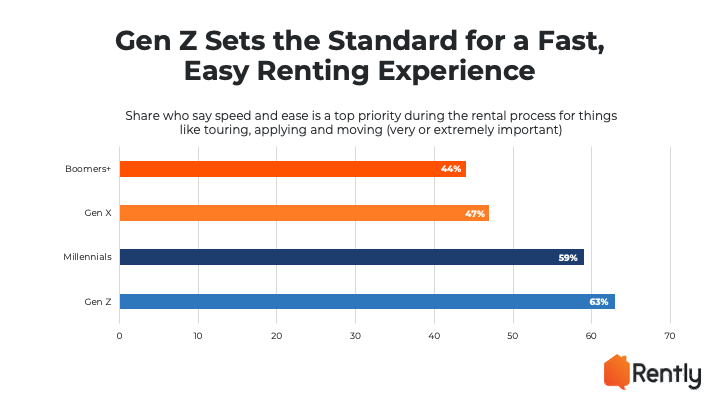
63% of Gen Z Say Speed and Ease Matter Most in the Renting Experience
For years, renting was framed as a short-term stop on the way to homeownership. But in 2026, long-term renting is becoming a deliberate housing strategy for millions of Americans.
High home prices, elevated mortgage rates, and persistent housing affordability challenges have made it harder for many households to justify or afford the leap from renting to owning. At the same time, expectations for the renting experience are rising. Speed, predictability, flexibility, and digital convenience now define what renters consider a worthwhile long-term option. The market is experiencing a broader shift in how Americans think about housing, stability, and what a successful adulthood looks like.
Against that backdrop, the Rently 2026 Renting by Generation Report explores the rentership tipping point: the moment when renting stops being a temporary phase and starts being seen as a realistic long-term option, whether driven by flexibility, convenience, or financial tradeoffs.
Rently partnered with the third-party survey platform Pollfish to conduct an online survey in January 2026 of 800 U.S. adults aged 18+ who currently rent an apartment, condo, or house. We explored how attitudes toward renting versus owning differ across generations, including motivations for renting, perceptions of long-term rentership, and future homeownership expectations.
Key Insights from the 2026 Renting by Generation Report
- 63% of Gen Z rate speed and ease as very or extremely important in the renting experience.
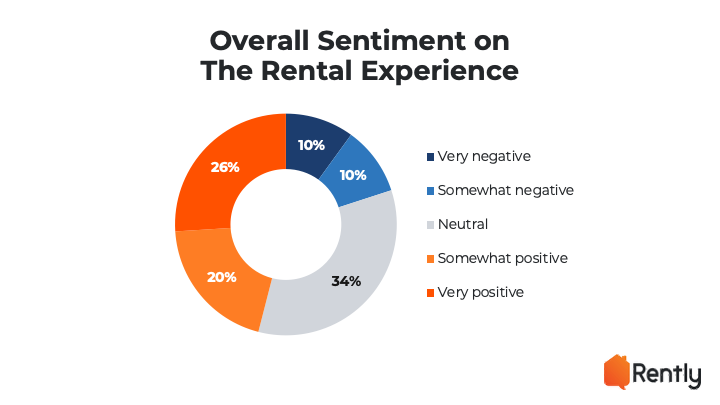
- 46% of renters describe renting as somewhat or very positive, compared with 20% who describe it as somewhat or very negative.
- 54% of renters say predictable monthly costs with no surprise charges make renting feel worthwhile long-term, and 53% say the same about having repairs and maintenance handled for them.
- 39% of Millennials and 34% of Gen Z view renting as a temporary step before owning, compared with 20% of Gen X and 16% of Boomers+.
- 49% of renters say long-term renting is more acceptable today than it was 10 years ago.
- 49% of Boomers+ feel no pressure at all to eventually own a home, while 33% of Gen Z say owning is very likely.
“Renting is no longer just a stepping stone to homeownership. For a growing share of Americans, it is a deliberate choice,” said Merrick Lackner, CEO at Rently. “In a market where buying can feel out of reach and flexibility matters more than ever, renters want speed, predictability, and real support. The rental experience should feel simple and responsive because for many households, renting truly feels like home.”
Renting Sentiment Tilts Positive
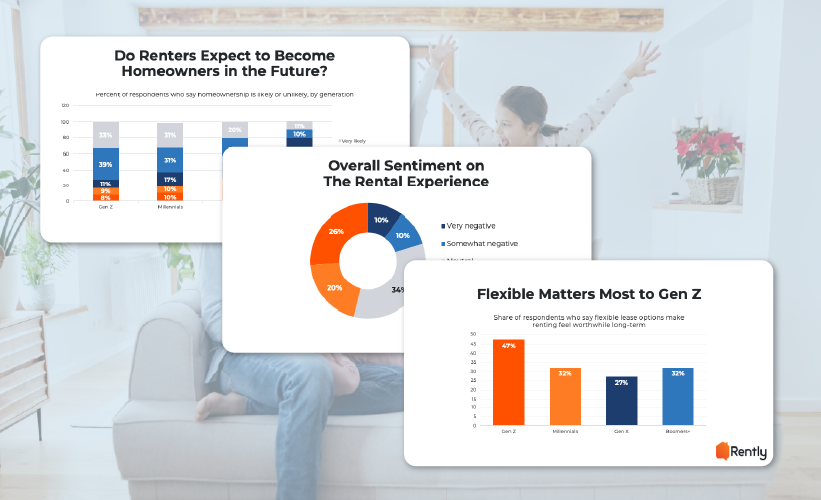
Renting is often discussed in the context of obstacles, but renters themselves describe a more balanced picture. 46% of respondents say renting feels somewhat or very positive, compared with 20% who say somewhat or very negative.
That matters for understanding the rentership tipping point. As renting becomes a longer-term reality for more people, the day-to-day experience carries more weight. A rental experience that feels smooth, supported, and predictable helps explain why renting can feel viable beyond a short transitional phase.
For Gen Z, Flexibility Is the Core Advantage of Renting
When renters talk about the benefits of renting, they often describe it in practical, lifestyle terms. Asked what they associate most with renting, the most selected themes are freedom to move or change plans (38%) and relief from ownership responsibilities (37%).
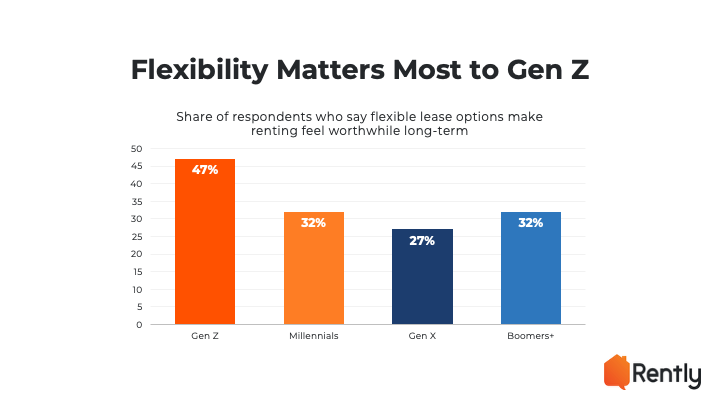
That flexibility is especially central for younger renters. Gen Z is the generation most likely to select flexible lease options as a feature that makes renting feel worthwhile long-term. 47% of Gen Z selected flexible lease options, compared with 32% of Millennials, 27% of Gen X, and 32% of Boomers+.
Along the same lines as flexible lease terms, 21% of Gen Z respondents say they are not interested in buying because they are not planning to stay in one place long-term, compared with only 5% of Boomers+. This reflects a younger renter mindset shaped by optionality and career-driven movement. For many younger adults, renting supports early-career mobility, evolving household needs, and the ability to adapt quickly without taking on the long-term obligations of ownership.
Renting does not automatically mean instability, though. When asked how they think about staying in one place, 44% of total respondents say they prefer to settle in one location. Another 32% say they like having the option to move even if they do not use it often. This points to a renter reality that can look stable and rooted, while still maintaining optionality.
Long Term Renting Is Becoming More Normal and Intentional
Renting is increasingly treated as a long-term plan, not a temporary phase. The clearest evidence is how renters describe their current approach, and how sharply those views differ by generation.
Younger renters are far more likely to describe renting as a step on the way to owning. 39% of Millennials and 34% of Gen Z say renting is a temporary step before owning, compared with 20% of Gen X and 16% of Boomers+.

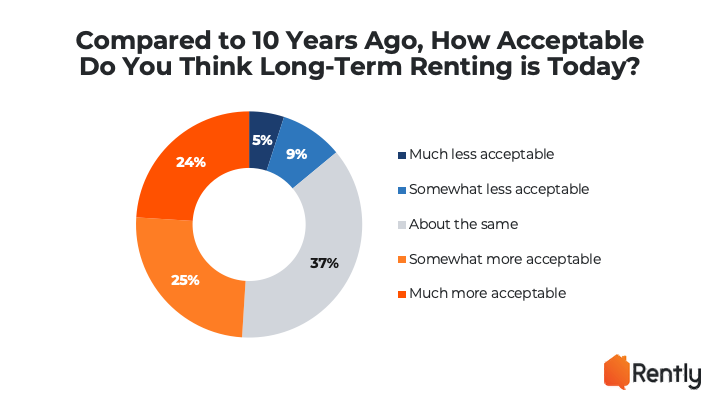
At the same time, renters increasingly see long-term renting as socially and culturally normal. Nearly half of renters say long-term renting is more acceptable today than it was 10 years ago (49%). That change in perception helps explain why renting can feel like a legitimate long-term option, not a deviation from adulthood milestones.
Another signal is how renting looks through the eyes of people who have already owned. 26% of respondents who have owned a home before say renting has turned out better than expected and that they enjoy it more now than they thought they would, compared with 16% of those who have never owned. In other words, even after experiencing homeownership, a meaningful share of renters find they prefer the convenience and simplicity renting can provide.
Housing Affordability Is Reshaping Renting Decisions for Younger Generations
Affordability remains the central barrier to buying. 56% of all respondents say they cannot afford a down payment or mortgage. That is the baseline reality behind many renters’ choices.
Economic conditions do not affect all renters in the same way. Younger renters report more active adjustments, especially when it comes to how they share space and manage costs.
Gen Z is most likely to say economic changes encouraged roommates or shared housing. 32% of Gen Z selected this, compared with 16% of Millennials, 13% of Gen X, and 5% of Boomers+. Gen Z is also most likely to say economic conditions made them consider moving to a less expensive area, at 41%, compared with 31% of Millennials, 26% of Gen X, and 24% of Boomers+.
These shifts speak to a younger renter reality defined by adaptation. Renters are finding ways to make renting work even when the broader housing environment is unstable.
Homeownership Still Matters, but Generational Expectations Differ
Homeownership still plays a major role in the American housing story, but the emotional relationship to “eventually owning” looks very different by age.
One of the clearest generational divides is pressure. 49% of Boomers+ say they feel no pressure at all to eventually own a home. For Gen Z, only 17% aren’t feeling pressured. This suggests that younger renters still often carry the cultural expectation of ownership, even when the market makes it harder to reach.
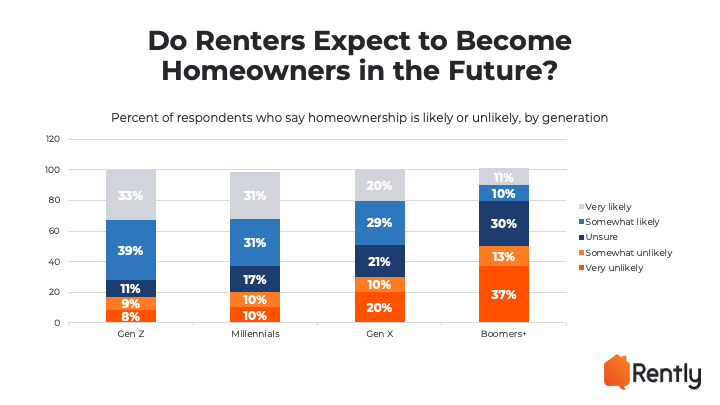
Expectations about owning show a similar generational pattern. Among renters, Gen Z is the most optimistic about owning. 33% of Gen Z believe owning is very likely, followed closely by Millennials at 31%, then Gen X at 20%, and Boomers+ at 11%. On the other end, 37% of Boomers+ say owning is very unlikely, compared with 20% of Gen X, 10% of Millennials, and 8% of Gen Z. These splits reflect both life stage realities and the different roles renting can play. Gen Z is early in the homeownership timeline and still building toward long-term milestones, while the older renters in this survey are those who are still renting after having more time and opportunity to buy. For many of those older renters, renting can feel like the more stable, settled choice, especially if they have already been through earlier housing phases and now prioritize simplicity and predictability.
Predictability and Support Define the Long Term Value of Renting
When asked what makes renting feel worthwhile for the long term, respondents most often point to support and predictability. Having repairs and maintenance handled becomes more important with age, rising from 41% of Gen Z to 63% of Boomers+. Predictability rises too, with “no surprise charges” for rent and amenities cited by 44% of Gen Z and 60% of Boomers+.
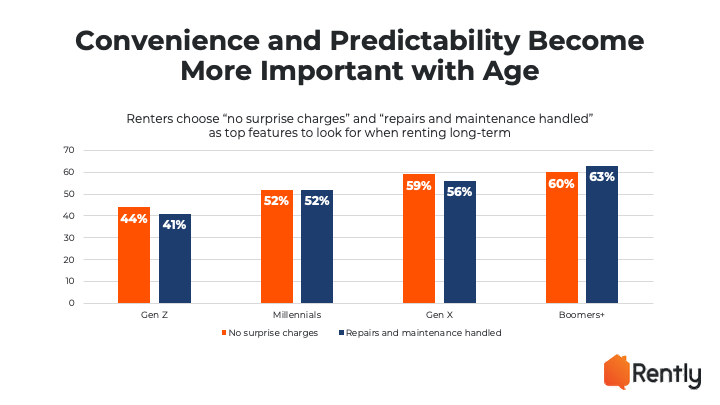
These differences emphasize that renting serves different needs at different life stages, and not all long-term renting is driven by the same motivation.
Gen Z Expects a Fast, Digital-First Renting Experience
As renting stretches longer for more adults, the day-to-day renting experience becomes more important. Renters want clarity, convenience, and responsiveness. Many renters value flexibility in touring itself, opting for self-guided tours that let them see properties on their own schedule without coordinating with leasing staff.
Speed and ease are core expectations of the modern renting experience. Overall, 54% of respondents rate speed and ease as very or extremely important for things like touring, applying, getting help, or moving out. That expectation is even stronger among younger renters. 63% of Gen Z rate speed and ease as very or extremely important, compared with 44% of Boomers+.
What the 2026 Rental Market Data Signals for the Future of Renting
Together, these findings point to a clear and rising experience standard in the rental market. Younger renters expect renting to feel fast, digital, and frictionless. Older renters place even greater weight on predictability, stability, and responsive support. While the priorities vary by life stage, the underlying expectation is the same: renting should make everyday life easier, not more complicated.
A larger shift is also taking place. Renting is no longer framed solely as a temporary phase before ownership. For many households, it is an intentional and long term housing strategy. As that shift continues, the quality of the renting experience carries more weight. Speed, transparency, flexibility, and reliable service are no longer differentiators. They are baseline expectations.
For operators and technology providers, this shift raises the bar. The rental experience must reflect how people live today: mobile, digitally fluent, and focused on convenience without sacrificing stability. Many operators are responding by investing in integrated tools such as a resident lifecycle management platform or AI leasing agents. The housing providers and platforms that meet those expectations will be better positioned to serve a renter population that is growing more diverse in age, priorities, and long term outlook.
Renting is evolving. And as it becomes home for more Americans, the experience must evolve with it.
Methodology
The Rently 2026 Renting by Generation Report is based on an online survey conducted by Pollfish in January 2026 among 800 U.S. adults ages 18+ who currently rent an apartment, condo, or house. Results are presented as percentages of respondents. Some questions allowed respondents to select more than one answer, so totals may exceed 100%.
Generational analysis in this report uses the following age group definitions:
- Gen Z: 18–27
- Millennials: 28–43
- Gen X: 44–59
- Boomers+: 60+